When Do I Read Torah Portion Achrai Mot
 | | ||
 | |||
 | |||
| | |
|
| ||||||||||||||||||||||||||||||||||||

| | |
| |||||||||||||
| | | ||
 | |||
 | |||
| | |
| The LORD spoke to Moses after the expiry of the two sons of Aaron, |
| | |
| The Warning of Nadab and Abihu |
|
| | |
| According to Jewish tradition, they reasoned that since ketoret (incense) was the holiest of offerings, and since the kodesh hakodashim (the Holy of Holies) was the holiest identify, it would be best if they offered their gift to the LORD there. Nadav and Avihu were substantially right that giving an offering before the Shechinah in the Holy of Holies was the well-nigh sacred of korbanot, just they transgressed by presumptuously coming earlier the LORD without His consent -- and without the blood of sacrifice for their sins (peradventure they were intoxicated as well: Lev. 10:9-10). Their death was a ways to sanctify the Proper name of the LORD, and to remind all Israel that it is indeed "a fearful affair to autumn into the easily of the Living God" (Heb. 10:31). After all, if Queen Esther feared for her life by coming before King Ahasuerus unbidden, surely the kohanim (priests) should fright coming before the LORD God Almighty without His approving. Therefore the LORD instructed Moses about how to come earlier His presence in the Holy of Holies and explained the special avodah (service) of Yom Kippur. |
| | |
| The Throne Room of God |
| | |
| The Holy of Holies is the antithesis of the profane -- the sacred place where God Himself would be manifest in the form of the Shechinah that dwelt (shachan) between the keruvim (Cherubim) over the kapporet (Seat of Amende) of the Ark of Testimony. Equally such, it was utterly sacred and represented the throne room of God Himself in the midst of Israel. |
|
| | |
| Access through claret atonement |
| | |
| But how, then, could State of israel come before the Male monarch of Israel, the LORD of Celebrity? Only through an appointed representative who came bearing the blood of atonement on behalf of the sins of Israel, and but on an appointed day (Tishri ten), otherwise known as Yom Kippur ("Day of Atonement"). On this special solar day, considered the holiest day of the twelvemonth, all of the korbanot (sacrifices) would be offered by the Kohen Gadol (Loftier Priest) solitary (i.east., not by any other priests) and only while he was divested of his "golden outward garments" and clothed exclusively in the white linen garments of humility. Earlier performing the blood rituals, however, the Loftier Priest first had to burn two handfuls of ketoret (incense) in the Holy of Holies. He would enter holding a spoon filled with ketoret in his left manus and a pan with burning coals in the other. He would carefully place the pan with the called-for coals in front of the ark then pour the ketoret from the spoon to his hands, which was then poured onto the glowing coals, filling the entire chamber with thick smoke. He would then walk slowly backwards, bowing before the Presence of the LORD. Side by side the High Priest would perform the boosted (musaf) sacrifices for the Yom Kippur service. These included animate being sacrifices for all of Israel (a bull, a ram, seven sheep, and a goat), too as the Kohen Gadol's personal korbanot (a bull for chatat offering and a ram for an olah). The High Priest would lay his easily upon the caput of the bull and recite viduy (confession) three separate times - offset for his own sins, then for the sins of the priesthood, and then for all of Israel. Then he would enter the Holy of Holies to sprinkle the blood of his chatat offering before the LORD. He would sprinkle the blood ane fourth dimension up and then 7 times down upon the kapporet ("Mercy Seat") of the ark. The flesh and the hide of the sin offerings were then taken "outside the camp" and burned. (Note that it was just during the Yom Kippur avodah that the sacred Proper noun of the LORD -- YHVH -- was spoken in total (at all other times the discussion Adonai was used in its place). In fact, the High Priest pronounced the sacred Name precisely 10 times on this occasion: three times during the viduy (confession) that itself was recited three times, and one more fourth dimension when performing the chatat offering of the goat that was designated "for the LORD" (run across below). When the people heard the High Priest recite the Name, they all brutal on their faces and said, "Barukh shem kevod malkhuto fifty'olam va'ed" - Blessed be the Proper noun (of the LORD) whose glorious kingdom endures forever." It subsequently became halakhah (Jewish police) that whenever the Name of the LORD was pronounced, it had to exist praised.) |
| | |
| The Two Goats |
| | |
| Ii goats were selected before and were waiting in the courtyard of the mishkan. The High Priest would depict lots and select one of the ii goats to be a chatat (sin) offer on behalf of the people (this caprine animal was designated L'Adonai - "to the LORD"). He would and so slaughter it and sprinkle its claret upon the kapporet as he did for his chatat offering before (this is the tertiary time the High Priest entered the Holy of Holies on Yom Kippur). |
|
| | |
| (A midrash relates that the people were then eager to get the Azazel goat thrust over the cliff that they sometimes ran alongside the messenger and pushed him along the manner.) |
| | | | | |
| The 4th and final archway into the Holy of Holies was when the High Priest returned to retrieve the spoon and the pan that had been used for burning the ketoret. While the Loftier Priest did this, the people would be fasting and praying in eager anticipation of the outcome of the rituals. After completing his tasks, the people cheered the High Priest and waited to kiss his hand at the entrance of the mishkan. The section on Yom Kippur avodah ends as follows: And it shall be a statute (chok) to you forever (olam) that in the seventh month, on the tenth solar day of the month (i.e., Tishri ten), you shall afflict yourselves and shall do no work (melakhah)... For on this day shall atonement (kaphar) be made for yous to cleanse you. You shall exist clean (tahor) earlier the LORD from all your sins. It is a Sabbath of solemn remainder to you (shabbat shabbaton), and you lot shall afflict yourselves; it is a statute forever (chukkat olam).... And the priest who is anointed and consecrated as priest in his begetter's place shall make atonement, wearing the holy linen garments (bigdei hakodesh). He shall brand atonement for the holy sanctuary (mikdash hakodesh), and he shall brand atonement for the tent of coming together (ohel mo'ed) and for the altar (mizbe'ach), and he shall brand atonement for the priests and for all the people of the assembly (am hakahal). And this shall be a statute forever (chukkat olam) for you, that atonement (kaphar) may exist made for the people of Israel one time in the year because of all their sins." And Moses did as the LORD commanded him (Lev. xvi:29-34). | ||||
| The Place of Cede | ||||
| Later on the laws for Yom Kippur were given, the parashah continues with the commandment that the Jews were only to offer their korbanot at the mishkan and not in the open fields where pagan sacrifices were offered. Those who violated this commandment were subject to | ||||
| Laws against eating Blood | ||||
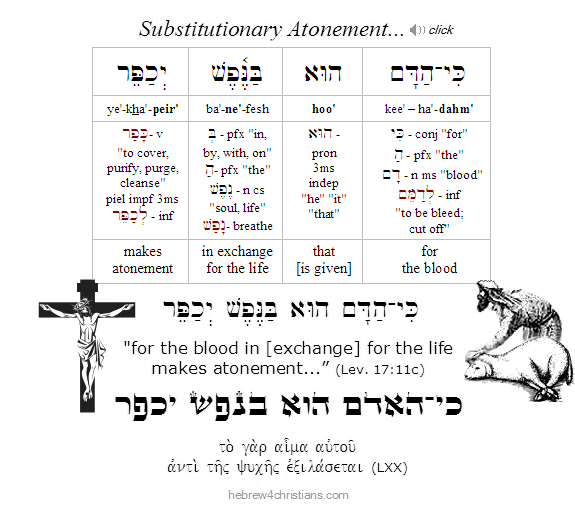
| Moreover the eating of claret is strictly forbidden and likewise subject to being kareit, having their lives "cut short": "For the life of the flesh is in the blood, and I have given it for you on the altar to make atonement for your souls, for it is the blood that makes amende by the life." (Lev. 17:11) The parashah concludes with commandments well-nigh deviant sexual relations, including incest, homosexuality, and bestiality. On business relationship of these practices the other nations were judged by the LORD and driven out of the land. | ||||
| Yom Kippur later on the Crucifixion of Yeshua | ||||
 (kareit), a "cutting short" of one's life.
| | |
| The Talmud relates fascinating information nearly various miracles that began occurring some 40 years before the devastation of the Temple (i.e., 30 Advertizement). These miracles are ascribed to the zechut (merit) of a certain Shimon HaTzaddik, who was a highly respected High Priest of Israel. Still, since these signs began merely afterward the time of Yeshua'southward crucifixion, they further indicate that the parochet of the Holy of Holies has been rent disconnected, and now, by ways of His avodah and zechut for those who trust in Him, the way to the throne of grace has been fabricated accessible to all. Hither's the quote from the Talmud: Our rabbis taught: During the last forty years before the destruction of the Temple the lot ['For the Lord'] did not come in the right hand; nor did the crimson-colored strap become white; nor did the western most light shine; and the doors of the Hekel [Temple] would open by themselves" (Soncino version, Yoma 39b). Co-ordinate to this passage, the lot for Azazel, contrary to all the laws of probability, came up forty times in a row in the left hand.... This was considered a dire event and signified something had fundamentally changed in the Yom Kippur avodah. The second phenomenon concerns a crimson strap that was tied to the Azazel caprine animal. The custom was to cut a portion of this strap and necktie it to the Temple door. Later the Azazel goat was killed, the strap on the Temple door turned white to signify the successful amende of Israel. However, beginning around 30 Advertizing, the strap remained blood-red each twelvemonth to the time of the Temple's destruction. The third miracle was that the ner ma'aravi, the westernmost ight of the menorah in the Holy Place, was found extinguished before the next forenoon. This was highly unusual considering earlier this time the ma'aravi remained lit throughout the night and was unremarkably used by the priests to rekindle the other branches of the menorah. After thirty AD, however, this lite -- the shamash -- was no longer found called-for, even despite various attempts to ensure that information technology remained lit through the night. The 4th miracle was that beginning around 30 AD the Temple doors swung open every night of their own accord. Yochanan ben Zakkai alleged that this was a sign of impending doom (Sotah 6:3) that foreshadowed that the Temple itself would exist destroyed. |
| | | | | | | |
 | ||||||
| Haftarah Reading Snapshot: | ||||||
| The Haftarah reading from Ezekiel 22 indicts State of israel for failing to obey the Torah of Moses and consequently invokes the judgment of the LORD, which includes the Diaspora of the Jewish people: "I will scatter you among the nations and disperse y'all through the countries, and I volition consume your uncleanness out of y'all. And yous shall be profaned by your own doing in the sight of the nations, and y'all shall know that I am the LORD." Notice, however, that the purpose of the Diaspora is to "eat the uncleanness" out of the Jewish people, and therefore is ultimately restorative. | ||||||
| | ||||||
| Brit Chadashah Reading Snapshot: | ||||||
| The Brit Chadashah reading tells us that the Mashiach Yeshua appeared as the High Priest (Kohen Gadol) of the truthful tabernacle (of which the earthly tabernacle was but a shadow) and there offered His ain blood to secure eternal redemption for those who are trusting in Him. Yeshua did this by dying on the cross and shedding His claret as the perfect sacrificial victim for the punishment of sins committed nether the Torah of Moses. In the first covenant (i.east., the Torah of Moses), innocent sacrificial victims had to be killed in society to benefit from their death. This is most evident in the Yom Kippur ceremony where the sins of the nation were covered by the "blood of bulls and goats" for the previous year'due south sins. Just this ritual, like the others instituted in the earthly tabernacle, foreshadowed the coming Substance that was prophesied (Hebrews 8:v). A testament is not of force until the testator is dead. That is, a "will" comes into upshot merely afterwards someone dies. The New Covenant of Almighty God was put into effect when Yeshua the Mashiach was sacrificed and died, and the heirs to this "volition" receive eternal forgiveness for their sins - unlike the contingent forgiveness obtained past the rituals offered in the earthly pattern of the true Holy Identify. Trying to alive under two covenants at the same time is similar to being married to ii women at in one case - which is a form of spiritual infidelity. Those who are joined ["married" KJV] to Mashiach are dead to (i.e., separated from) the Torah of Moses (Rom. seven:2-4). You also have died to the Torah through the trunk of Christ Praise the God of Israel for our High Priest Jesus, the Mediator of the New Covenant through His sacrifice for us! Ane of the roles of our beloved Mashiach Yeshua (Jesus Christ) is that of Kohen HaGadol (High Priest) who offered true kapparah [atonement] for our sins by offering His own blood in the Holy of Holies fabricated without hands. As it is written in the alphabetic character of Hebrews: Therefore, holy brothers, yous who share in a heavenly calling, consider Jesus, the campaigner and high priest of our confession, who was faithful to him who appointed him, just as Moses also was true-blue in all God'southward house. (Hebrews 3:ane-2) | ||||||
| The Importance of a Blood Sacrifice | ||||||

| | |
| In Leviticus 17:11 it is written: "For the life of the flesh is in the blood, and I have given it for you on the altar to absolve (l'kapeir) for your souls, for information technology is the claret that makes amende (y'khapheir) past the life." A blood sacrifice is required past the LORD for the issue of sin. Leviticus 17:xi agrees with Hebrews 9:22: "Without the shedding of blood there is no remission." In Yoma 5a it is too written, "There is no atonement without blood." The substitutionary shedding of blood, the "life-for-life" principle, is essential to the true "at-one-ment" with the LORD God. Yeshua offered His own torso up to be the perfect Sacrifice for sins. By His shed claret we are given complete atonement before Adonai. The Levitical system of animal sacrifices, including the elaborate Yom Kippur ritual, was meant to foreshadow the true and abiding Cede of Yeshua as the means of our reconciliation with God. The B'rit Yeshanah (Older Covenant) provides a shadow of the substance revealed in the B'rit Chadashah (New Covenant). If the older covenant had been sufficient to provide a permanent solution to the problem of our sin, in that location never would have been need for a new covenant to supervene upon information technology (Hebrews 8:7). Nether the former or older covenant, sacrifices merely "covered" sins, but under the new covenant, these sins are taken entirely away (Hebrews 7:27, 9:12, ix:25-28). There is no more need for continual sacrifices, since Yeshua provided the once-and-for-all sacrifice for all of our sins (Hebrews 9:11-14; 9:24-28; 10:11-20). Indeed, Yeshua is the "propitiation" or "expiation" for our sins. The Greek word used in Romans 3:25, 1 John 2:2, and 1 John iv:10 ("hilasterion") is the same discussion used in the LXX for the kapporet [seat of atonement on the ark of the covenant] in the Holy of Holies which was sprinkled with the blood of the sacrifice on Yom Kippur. For Messiah has entered, not into holy places made with hands, which are copies of the true things, but into sky itself, at present to announced in the presence of God on our behalf. Nor was it to offer himself repeatedly, as the high priest enters the holy places every year with blood not his ain, for then he would have had to suffer repeatedly since the foundation of the world. Only as it is, he has appeared once for all at the cease of the ages to put away sin by the cede of himself... And so Messiah, having been offered once to bear the sins of many, volition appear a second time, not to deal with sin but to salve those who are eagerly waiting for him. (Hebrews 9:24-ff) For by one offer he hath perfected for ever them that are sanctified.
Blessing: |

| | | |
| For Further Study: | ||
|
| | |
| Click the following links to hear the desired chapters read from this calendar week's Torah: |
| | |
| | | | | | |
| Hebrew for Christians | |||||
 | |||||
| | |||||
campbelllationd1950.blogspot.com
Source: https://www.hebrew4christians.com/Scripture/Parashah/Summaries/Acharei_Mot/acharei_mot.html
0 Response to "When Do I Read Torah Portion Achrai Mot"
Post a Comment